

Plant Molecular Biology
Plant Stress and Nutrient Physiology
Multi-Omics Approaches
Bioinformatics
GWAs

アグラハリ ラジ・キシャン
AGRAHARI RAJ KISHAN
2026年度採用
岐阜大学
高等研究院/応用生命科学科
G-YLC特任助教
専門分野
キーワード
Arabidopsis thaliana
Stress and Nutrient response
Peptidome
所属学協会
Japanese Society of Soil Science and Plant Nutrition (JSSSPN)
Japanese Society of Plant Physiologists (JSPP)
主な研究内容
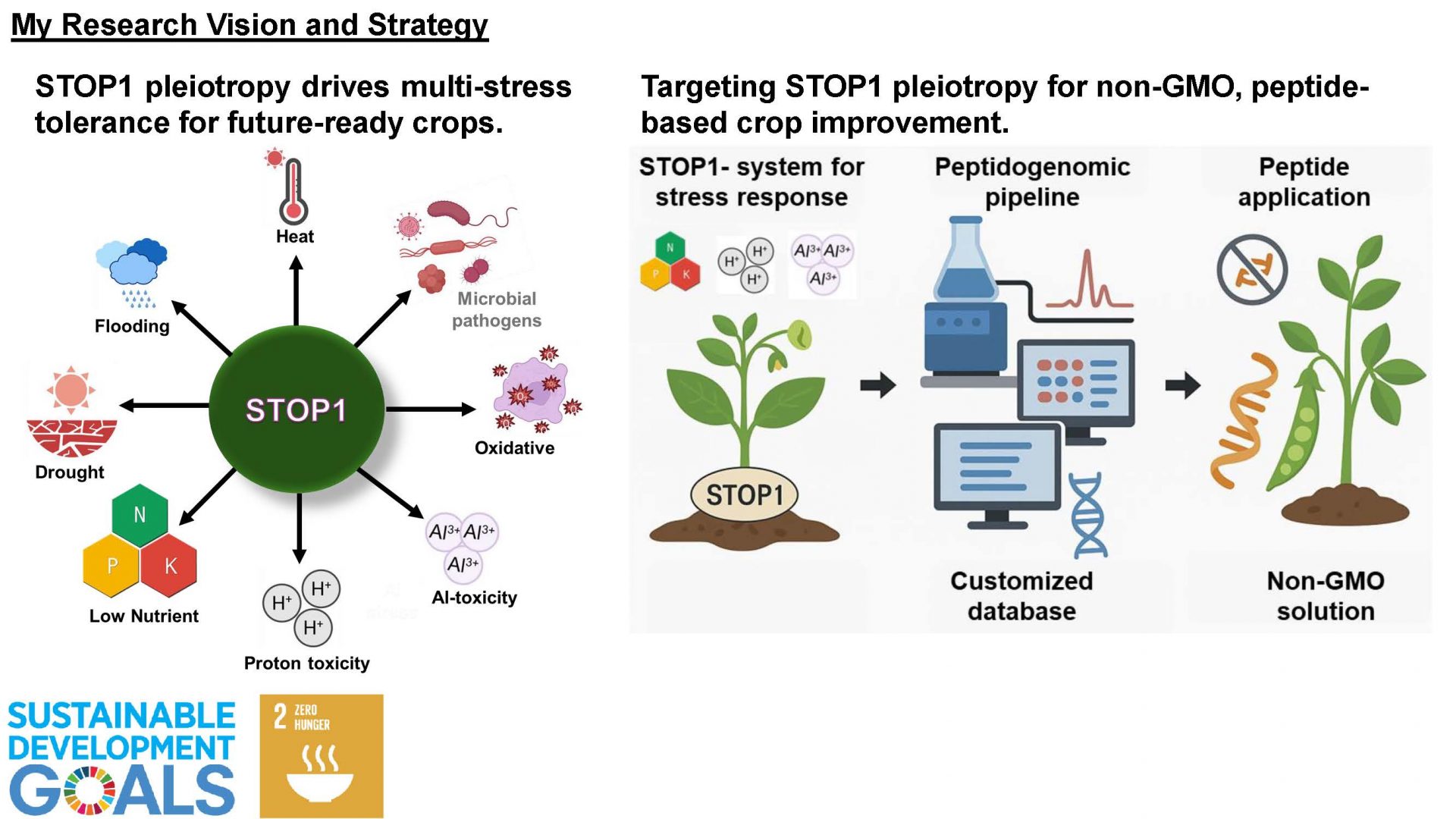
My research focuses on plant stress biology and molecular adaptation, with a particular emphasis on how plants respond to environmental constraints such as soil acidity, aluminum (Al) toxicity, and nutrient imbalance (N, P, K). I am especially interested in the transcription factor STOP1 (SENSITIVE TO PROTON RHIZOTOXICITY 1), a pleiotropic master regulator that coordinates multiple stress response pathways, including H⁺ toxicity, Al resistance, and nutrient uptake. My work aims to elucidate how STOP1 integrates these signals to sustain plant growth under adverse environmental conditions.
To address this, I employ a multidisciplinary approach integrating transcriptomics, peptidomics, ionomics, and computational analysis. While transcriptomic studies have identified key STOP1-regulated genes, an important regulatory layer remains largely unexplored: small peptides encoded by small open reading frames (sORFs). These peptides are increasingly recognized as critical regulators of signaling and protein function. I am developing a “peptidogenomics” framework to systematically identify and characterize STOP1-regulated peptides and to uncover their roles in plant stress adaptation.
Building on findings from the model plant Arabidopsis thaliana, I aim to translate these insights into practical applications in legume crops such as mung bean and azuki bean. A key goal is to establish non-genetically modified (non-GMO) strategies by applying synthetic peptides externally to enhance stress tolerance and nutrient-use efficiency. This approach provides a sustainable alternative to conventional agricultural inputs.
I am particularly interested in establishing interdisciplinary collaborations in plant molecular biology, bioinformatics, peptidome, and crop science. Collaborative research integrating advanced omics technologies, machine learning, and field-based studies will be essential to accelerate the translation of fundamental discoveries into practical agricultural solutions. Through such partnerships, I aim to contribute to the development of climate-resilient crops and sustainable agricultural systems.
論文
[1] Agrahari, R. K., Kobayashi, Y., Enomoto, T., Miyachi, T., Sakuma, M., Fujita, M., Ogata, T., Fujita, Y., Iuchi, S., Kobayashi, M., & Yamamoto, Y. Y. (2024). STOP1-regulated SMALL AUXIN UP RNA55 (SAUR55) is involved in proton/malate co-secretion for Al tolerance in Arabidopsis. Plant Direct, 8(1), e557.
[2] Koyama, H., Wu, L., Agrahari, R. K., & Kobayashi, Y. (2021). STOP1 regulatory system: centered on multiple stress tolerance and cellular nutrient management. Molecular Plant, 14(10), 1615–1617.
研究紹介
本事業を通じて解決を目指す世界的課題
Development of non-GMO strategies for crop stress resilience using STOP1-regulated peptides
Global agriculture faces serious challenges due to soil acidity, nutrient imbalance, and inefficient fertilizer use, which reduce crop productivity and harm the environment. Acidic soils limit root growth and nutrient uptake across a large portion of arable land, while excessive fertilizer application leads to water pollution and greenhouse gas emissions. Although genetic approaches have improved stress tolerance, their application is often limited by regulatory and social concerns. In this project, I focus on STOP1, a key regulator of plant stress responses, and explore small peptides as a novel way to control these pathways without genetic modification. By identifying and applying STOP1-regulated peptides, this research aims to develop a sustainable, non-GMO strategy to enhance crop resilience and nutrient-use efficiency. This approach contributes to environmentally friendly agriculture and supports global food security.
インタビュー
インタビューはありません
関連ニュース
関連ニュースはありません