

Times of Materials
Aging of Polymers
Construction and Building Materials

ISHIDA Takato
2026年度採用
Graduate School of Engineering, Nagoya University
Department of Materials Physics
Assistant professor
Research fields
Research Interests
Heterogeneous Aging
Ultra-Durable Polymers
Non-ergodicity
Reactive Coarse-Grained Molecular Dynamics
Rheology
Professional Memberships
Materials Life Society, Japan
The Society of Polymer Science, Japan
The Japanese Society of Rheology
Architectural Institute of Japan
The Society of Rubber Science and Technology, Japan
Main research topics
My research is centered on the theme of “materials × time.” As concern over environmental issues continues to grow, the message that we should use various products for as long as possible seems to be gaining broad acceptance in society. My central interest lies in the science of how materials change over time during long-term use, and whether such changes are desirable or undesirable from the perspective of those who use them—in other words, the science of the time experienced by materials.
Among these topics, I have been particularly focusing on the degradation of polymeric materials (plastics). In recent years, against the backdrop of the finite nature of petrochemical resources, demands for the long-term use and circular use of polymeric materials have been increasing rapidly. The science of polymer aging is a fundamental academic field that underpins solutions to social challenges in an era of resource constraints and the circular economy, and I am convinced that it will continue to be an indispensable field supporting industry and society in the future. Until now, I have mainly worked on establishing the scientific principles underlying aging phenomena. Going forward, based on these insights, I aim to realize ultra-durable polymers that do not suffer property deterioration during service, or that can maintain performance with only minimal maintenance intervention.
Recently, I developed a molecular simulation method that explicitly incorporates the radical transport dynamics arising during the oxidative aging and decomposition of polymers. Using this approach, I have shown that the degradation of plastics progresses spatially in a highly heterogeneous manner. I believe that if stabilizer molecules with precisely controlled molecular size and dynamics can be made to act selectively on these localized degradation regions, the degradation of polymeric materials can be significantly suppressed. To translate this design concept into practice, I hope to promote broad industry–academia collaboration.
Ultra-durable polymeric materials would not only contribute to highly efficient resource circulation and the minimization of environmental impact, but would also be extremely valuable in applications used in harsh environments where maintenance is difficult. Potential examples include polymeric materials for space satellites, cables for nuclear power plants, and underground buried pipes. I hope to extend the scientific principles of degradation to such extreme environments as well, and to contribute to their understanding and control.
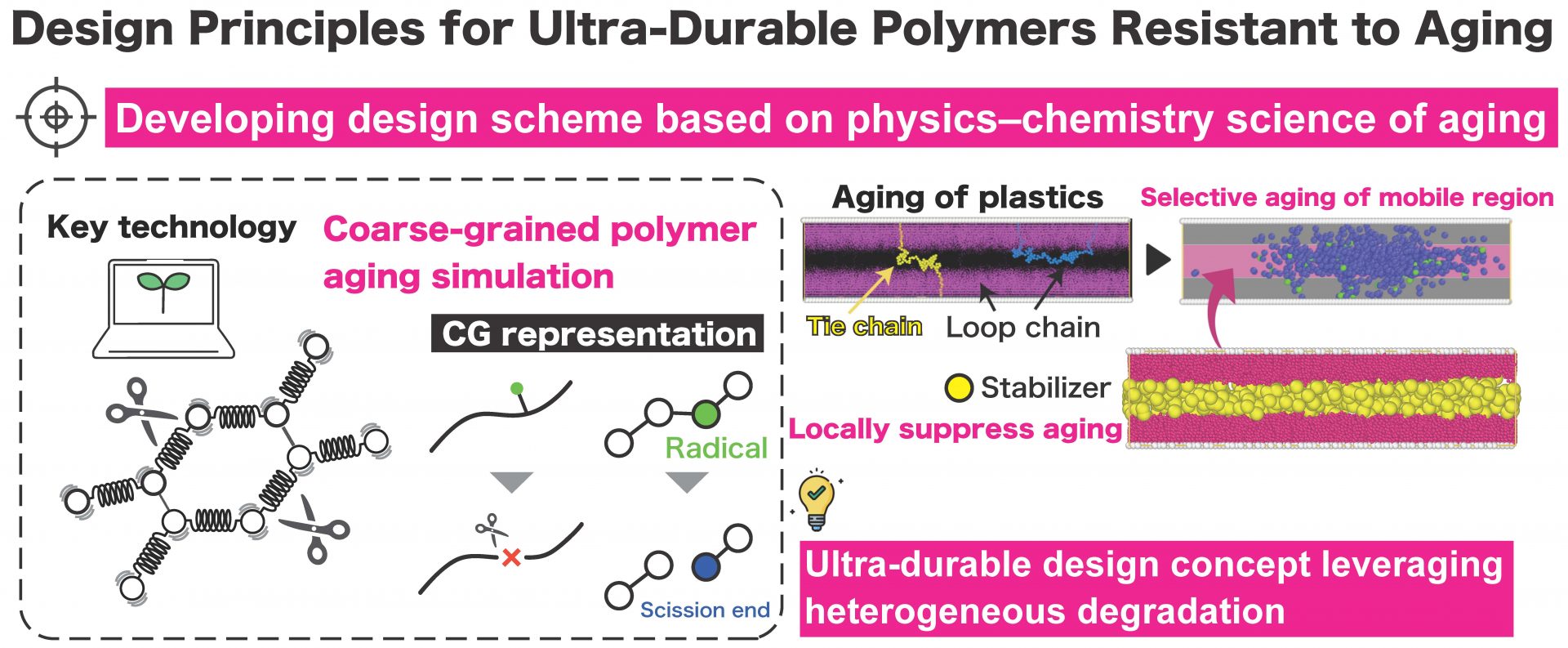






Representative papers
Takato Ishida, Yuya Doi, Takashi Uneyama, and Yuichi Masubuchi, “Modeling for heterogeneous oxidative aging of polymers using coarse-grained molecular dynamics”, Macromolecules, 56, (2023) , 21, 8474-8483.
Takato Ishida and Emmanuel Richaud, “Coarse-Grained Molecular Dynamics Simulations of Oxidative Aging and Stabilization in Polymer Melts with Primary Antioxidants: Effects of Antioxidant Concentration and Molecular Architecture”, submitted to Journal of Vinyl and Additive Technology (2026), vnl.70104. https://doi.org/10.1002/vnl.70104.
Research URL
Global issues to be solved through this project
Design Principles for Ultra-Durable Polymers to Suppress Degradation-Triggered Circularity Failure and Micro/Nanoplastic Leakage into the Environment
Promoting plastic resource circulation and reducing environmental burdens are urgent global challenges. However, even when recyclable polymers or environmentally adaptive plastics are used, degradation during service is unavoidable. In fact, degradation of polymeric materials not only lowers recycling efficiency but also accelerates the release of microplastics, which are increasingly recognized as a threat to ecosystems. Therefore, suppressing degradation as much as possible is one of the most important strategies for preserving the long-term resource value of plastics. In this project, in collaboration with industrial partners, we aim to establish design principles for ultra-durable polymers based on a fundamental understanding of degradation mechanisms. These principles will then be translated into practical materials design, providing a pathway toward social implementation. Through this approach, the project seeks to contribute both to sustainable plastic use and to the development of materials with greatly extended service lifetimes.
Interview
No interview
News
-
お知らせ
T-GEx Fellow Dr. ISHIDA Takato (Nagoya University) Appointed to the Advisory Board of the Journal of Vinyl and Additive Technology
-
お知らせ
T-GEx Fellow Dr. ISHIDA Takato (Nagoya University) Appointed as a Director of the Materials Life Society
-
お知らせ
A paper by T-GEx Fellow Dr. ISHIDA Takato has been published in a special issue of the Journal of Vinyl and Additive Technology