

Digital Humanities
Philology
Indian Philosophy and Literature
South Asian Studies

TANIGUCHI Chikamitsu
2026年度採用
Nagoya University
Institute for Advanced Research /Graduate School of Humanities
YLC Designated Assistant Professor
Research fields
Research Interests
Hindu Law
Actor-Network Theory
Linked Data
Knowledge Graph
Professional Memberships
The Japanese Association of Indian and Buddhist Studies
Association for the Study of the History of Indian Thought
American Society for Premodern Asia
Canadian South Asian Studies Association / Association canadienne d’études sud-asiatiques
Main research topics
My research investigates how Hindu law was constructed and reconfigured in modern South Asia through the interaction of texts, institutions, and practices. My primary sources include Sanskrit legal texts, commentaries, legal opinions, court records in English and other modern languages, and historical materials from the colonial and modern periods. In particular, I am interested in how traditional legal knowledge was connected to, and transformed by, modern judicial institutions and local social practices. In this way, I aim to reconsider Hindu law not as a fixed system, but as a dynamic body of knowledge formed through relationships among multiple actors and media.
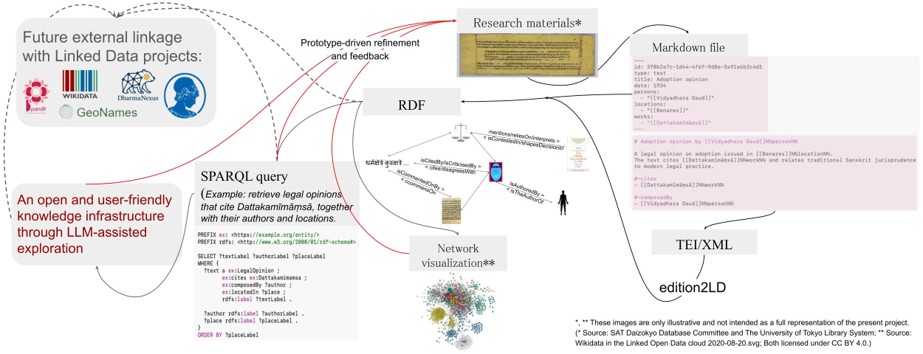
Methodologically, my work is grounded in philology while also drawing on perspectives from Indology, South Asian Studies, the sociology of knowledge, and Actor-Network Theory. This allows me to analyze not only the interpretation of individual texts, but also the educational, institutional, and social conditions under which legal knowledge was produced, circulated, and received. As an infrastructure supporting this philological and sociological research, I am also developing a knowledge base using Linked Data. By connecting persons, texts, legal concepts, geographical information, organizations, and textual fragments, this project seeks to bring together historical materials that have often been treated separately and to visualize and reassess the processes through which legal knowledge was formed. At the same time, this is also an attempt to approach the formation of legal knowledge in a more relational and interconnected way, while promoting broader access to and international sharing of scholarly knowledge.
As a T-GEx Fellow, I hope to move back and forth across these three orientations—philology, the sociology of knowledge, and digital humanities—in order to reconstruct more fully the complex processes through which knowledge surrounding Hindu culture has been formed, and to develop this work into an interdisciplinary project spanning South Asian Studies, legal history, and the digital humanities.

Representative papers
TANIGUCHI, Chikamitsu. 2023. “Complicating Taxonomy of Sons: Aurasa, Anulomaja, and Śūdrāputra.” Studies of Buddhist Culture 23: 112–140.
Research URL
Global issues to be solved through this project
Construction of an Open Academic Knowledge Infrastructure for Visualizing Hindu Intellectual Networks and Their Historical Formations beyond South Asia
This project addresses a global challenge in which historically and academically verifiable knowledge is not made sufficiently visible in today’s information environment and is instead circulated and consumed in fragmentary and oversimplified forms, a tendency further amplified in the age of LLMs. In particular, knowledge concerning religion, law, and culture in South Asia is often received within political and social contexts without adequate understanding of the historically complex processes through which it has been constructed. Focusing on knowledge surrounding Hindu culture, this project aims to build a critically verifiable knowledge infrastructure and thereby contribute to more open access to scholarly knowledge and to its international circulation. By doing so, it also seeks to relativize what may be called “fast knowledge” and to reduce the intellectual burden required to connect simplified claims with knowledge that can be critically examined and historically grounded.
Interview
No interview
News
No related news