

Virology
Microbiology
Oral Science
Genomics
Nano-biomedical engineering
WATANABE Takahiro
2026年度採用
Nagoya University
Department of Virology,Graduate School of Medicine
Lecturer
Research fields
Research Interests
Symbiotic Viruses
Herpesviruses
Host-Microbe Interactions
Disease Omics
Novel Virus Discovery
Professional Memberships
Japanese Society for Virology
Japanese Society of Clinical Virology
Japanese Society of Oral and Maxillofacial Surgeons
Japanese Association for Oral Biology
Japanese Society of Dentistry for Medically Compromised Patient
Main research topics
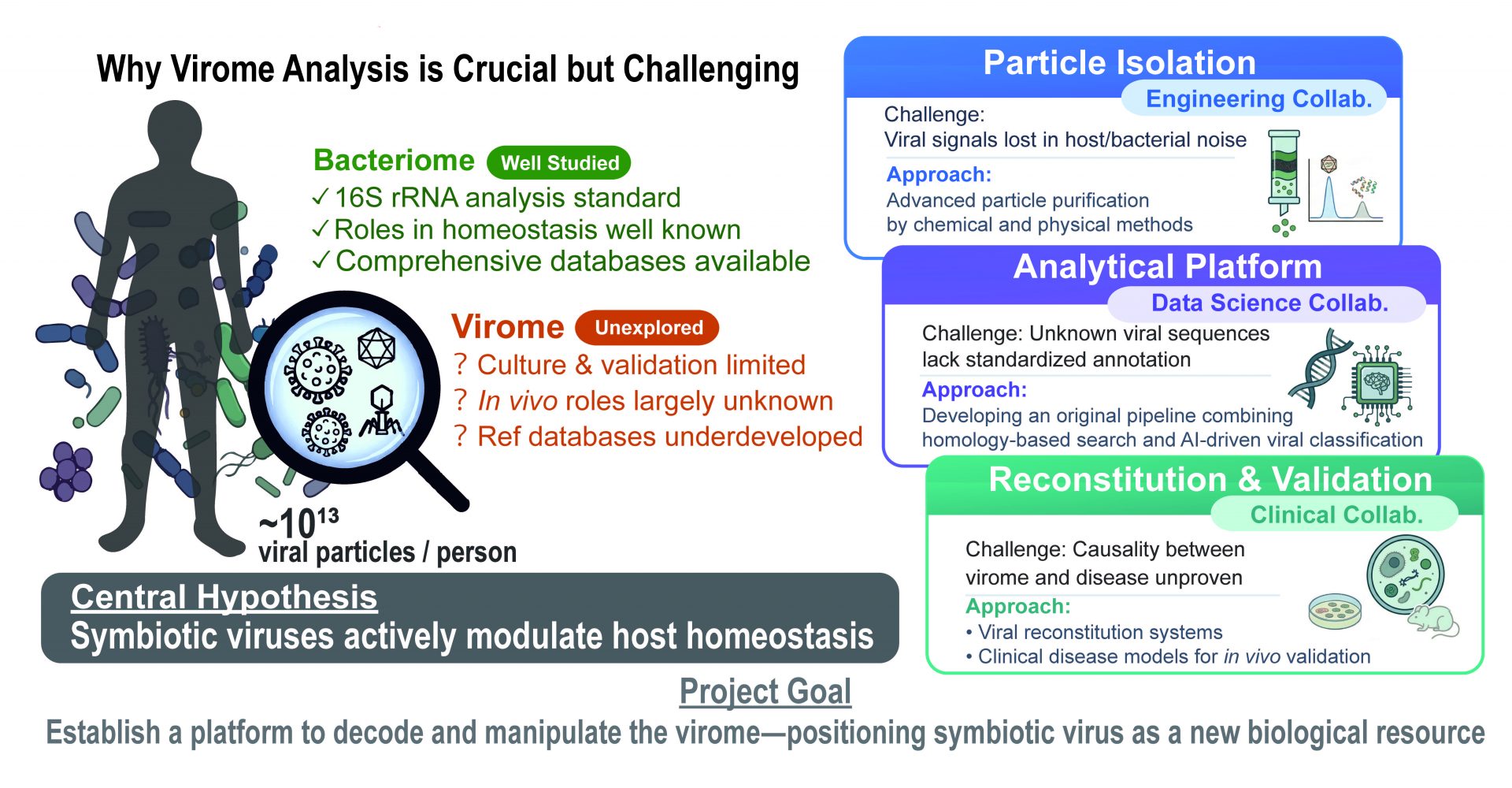
Our health is supported by microbes living inside our bodies. Recent advances in bacteriome research have revealed that symbiotic bacteria play a key role in host homeostasis—keeping our bodies in balance. In contrast, the virome remains largely unexplored due to limited databases and technical challenges.
In this project, we propose that the virome actively modulates host homeostasis, termed “Virome modulation,” and aim to build a technology platform to decode and manipulate the virome. Toward this goal, we will collaborate with experts in engineering, genomics, and other fields to address three key challenges:
1. How do we isolate viruses? — To efficiently read viral genomes, we will develop innovative particle separation methods through medical-engineering collaboration.
2. How do we decode unknown sequences? — Using AI and machine learning, we will build a next-generation informatics platform to assign functional annotations to unknown sequences.
3. How do we translate sequence data into biological reality? — Going beyond data, we will use synthetic biology to reconstruct discovered viruses and validate their roles in vivo.
We will start with saliva samples, which are easy to collect and non-invasive, and expand from the mouth to other body sites such as the gut and respiratory tract, exploring how the virome interacts with these environments. This will build a foundation for preemptive medicine focused on disease prediction and prevention. Furthermore, we aim to apply the technology platform established in this project to a wide range of research fields, including infectious disease research, positioning symbiotic viruses as a new “biological resource” for the future of life sciences.




Representative papers
1) Md Kamal Uddin, Takahiro Watanabe (co-corresponding), Masataka Arata, Yoshitaka Sato, Hiroshi Kimura, and Takayuki Murata, “Epstein-Barr Virus BBLF1 Mediates Secretory Vesicle Transport to Facilitate Mature Virion Release,” Journal of Virology 97 (2023) no.6, e0043723
2) Yuya Hara, Takahiro Watanabe (co-corresponding), Masahiro Yoshida, H. M. Abdullah Al Masud, Hironori Kato, Tomoko Kondo, Risa Suzuki, Shoko Kurose, Md Kamal Uddin, Miku Arata, Shota Miyagi, Yusuke Yanagi, Yoshitaka Sato, Hiroshi Kimura, and Takayuki Murata, “Comprehensive Analyses of Intraviral Epstein-Barr Virus Protein-Protein Interactions Hint Central Role of BLRF2 in the Tegument Network,” Journal of Virology 96 (2022) no.14, e0051822
Research URL
Researchmap https://researchmap.jp/takahirowatanabe
Global issues to be solved through this project
Establishment of an Integrated Research Platform to Transform Symbiotic Viruses into Biological Resources
The human body is home to an immense number of viruses — estimated in the tens of trillions — yet we know almost nothing about most of them. Viruses are commonly associated with disease, but many may, in fact, play an important role in keeping us healthy. The challenge is that viruses vary widely in their physical structure, and in biological samples, their signals are easily buried under vast amounts of host genomic data, making them very difficult to analyze. This research brings together virology, engineering, and data science to discover previously unknown viral sequences and uncover what they do — exploring how the viruses living within us might help address challenges across life, the environment, and beyond.
Interview
No interview
News
No related news