

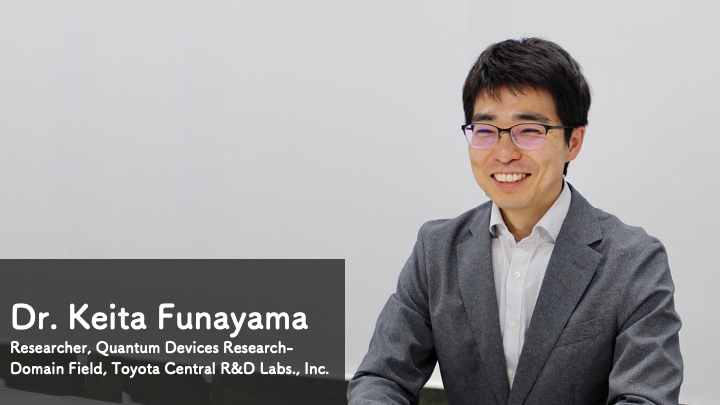
Dr. Funayama is advancing research aimed at developing a new type of circuit that uses “waves” to transmit information. As a researcher at Toyota Central R&D Labs., Inc., he spent two years as a T-GEx Corporate Associate. What was that experience like?
──You’ve spent two years on the program, and your term will conclude at the end of March. How are you feeling now?
Well, it feels like I’m graduating. I had just started to feel comfortable talking more openly with the faculty members I'd gotten to know, so I’m simply sad that it's ending.
──We feel the same way. Could you tell us how you first joined T-GEx?
Of course. Actually, I first learned about T-GEx after being approached internally—it wasn’t so much my own initiative. I was told something like, “There’s a project like this. Would you like to participate?” In fact, several other people were also approached, and internal interviews were held after that.
──So you made it through a highly competitive internal selection process.
Looking back, yes, I suppose that's true (laughs). When I was first approached, I thought, “This sounds interesting.” After reading more about T-GEx on its website, I learned that it was an educational program for early-career researchers. It also happened to be a time when I was hoping to learn the skills needed to lead a team in the future, so I raised my hand and applied.
──I see. So that’s why you actively participated in so many of the T-GEx programs?
I took part in all the programs I could. Among them, I personally found the leadership program and the RetreatCamp to be particularly beneficial.
──What aspect of the leadership program was the most memorable for you?
Each session covered different topics, so it’s difficult to choose just one. What stood out to me throughout the program was the number of questions with no clear answers. I felt that the specialist instructors in each session taught us the importance of always making the best decision, even when there is no single right answer. I learned to see things from perspectives I had never considered before; it was a very valuable experience.
──That makes sense. You also served as one of the organizers for the retreat. Was it a lot of work for you?
That was the Retreat Camp in my first year. I decided to leave the discussions on complex research topics to the faculty members (laughs). We only had occasional meetings, so it hardly felt like a burden at all. I even found myself wondering whether it was really okay that it felt that easy for me. There were two things I wanted to try at the retreat. I proposed them to the organizing committee, and both were approved. The first was to hear the honest thoughts of faculty members from the same generation about the challenges and concerns they face. The second was to explore what kind of understanding might emerge when people with opposing opinions openly exchanged their views.
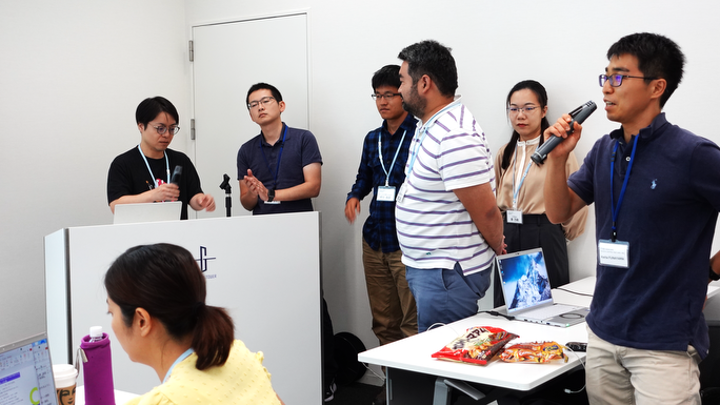
Dr. Funayama serving as one of the organizers at the AY 2024 T-GEx retreat (first on the right)
──Both sessions generated a lot of lively discussion at the retreat. What did you gain from those experiences?
I was interested in seeing how conflicting opinions would be resolved and what kind of mutual understanding would emerge when outstanding faculty members participating in T-GEx came together. One example was the theme of "industry vs. academia." When we actually tried it, we couldn’t reach a conclusion in such a short time. However, what I found valuable was that many flexible perspectives emerged, such as, “It’s hard to reach a conclusion,” and “When you consider both sides, it’s not easy to make a simple decision.”
──What kind of significance did you find in the fact that no clear answer could be reached?
In my current environment, I feel that opinions like “this is correct,” or “since it has always been done this way, it should be done this way” are relatively common. I often wonder whether this is simply due to the corporate environment or whether things would be different in another group. That’s why it was so meaningful for me to experience a different way of thinking through T-GEx.
──Would you say the experience changed the way you think about other people’s perspectives? So, your experiment was a great success (laughs).
Yes, I was very satisfied. I felt that being in a company environment tends to narrow our opinions and ways of thinking, so I wanted to bring in some fresh perspectives. I often shared ideas within the company by saying things like, “When I talked about this with outstanding university faculty members, this was their perspective.” It felt like saying, “This has the T-GEx faculty’s stamp of approval!" (laughs).
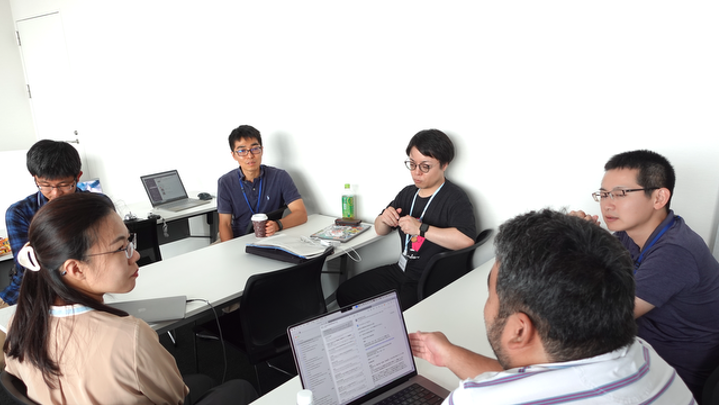
Group work at the AY 2024 Retreat Camp (Dr. Funayama is pictured at the back, wearing a navy polo shirt.)
──That’s one of the great things about participating in T-GEx! From the perspective of a corporate researcher, what differences did you notice compared to academia?
I think it was learning about the sheer depth of academic research conducted by university faculty. I felt this strongly during our research discussions, and it was very inspiring. On the other hand, I also felt that corporate researchers have a stronger ability to create marketable products. The two sides operate in different ways, and it was very meaningful to experience those differences firsthand.
─Understanding those differences is important when moving things forward together. Do you think you’ll be able to make use of what you learned in the future?
Yes. I hope to share what I learned and experienced at T-GEx broadly within my company and pass them on to younger generations. I believe it is important for industry and academia to connect and work together to address global challenges while leveraging their respective strengths. In that context, I would like to be involved in nurturing young talent by creating an environment where the next generation—and the generation after that —can fully demonstrate their abilities. At the same time, I also hope to contribute as a researcher who can bridge industry and academia.
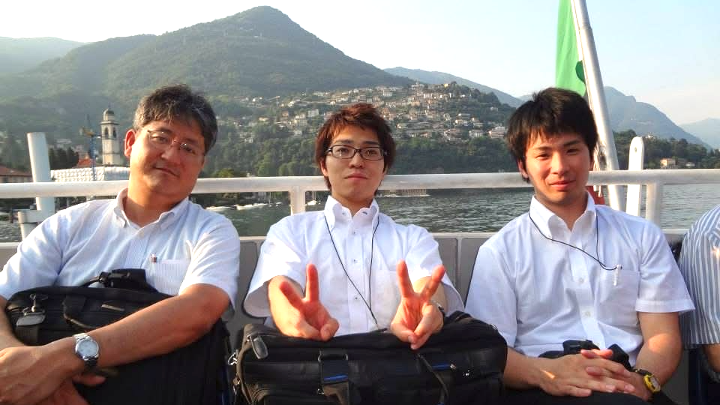
【Memories with his mentor who inspired Dr. Funayama to become interested in developing young talent】At the root of Dr. Funayama's commitment to educating younger generations is his graduate school mentor, Dr. Koji Amezawa (Professor, Institute of Multidisciplinary Research for Advanced Materials, Tohoku University) (far left). For Dr. Funayama (center), then a graduate student, Dr. Amezawa was a source of inspiration both as an educator and as a researcher, and that influence continues to this day.
──Those are very inspiring words for the future! Finally, do you have a message for the T-GEx Fellows, Associates, and Corporate Associates?
To all the Fellows and Associates, I hope you will go on to become leaders in your fields and don’t forget to reach out to me (laughs)! Let’s work together on big research projects. I would also be happy if we could work together to help develop the next generation of researchers. By sharing our insights and experiences with students who have limitless potential, I hope we can help nurture an even stronger future generations of researchers. Looking ahead to the next generation—and the one after that—I hope we can continue moving forward together.
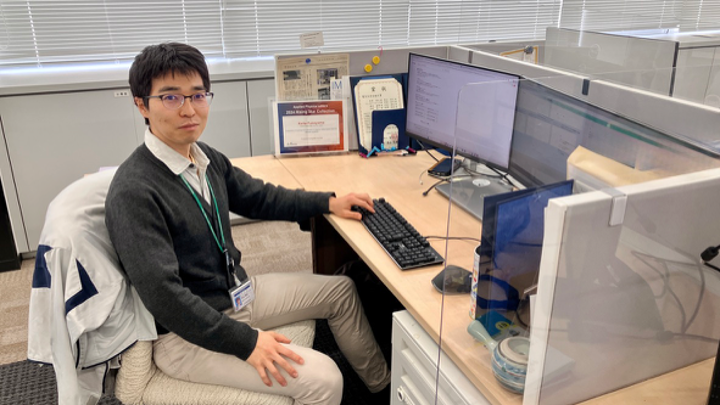
【Dr. Funayama at Toyota Central R&D Labs】“This is where I usually work,” says Dr. Funayama.
──Serving as a bridge between research and education, and between industry and academia, the future Dr. Funayama envisions already extends to the next generation and beyond. We look forward to seeing what kind of “waves” his ongoing challenges will create. We sincerely wish him continued success.
Interview: Mayuko Kumasaka (URA, Academic Research & Industry-Academia-Government Collaboration)
Text: Tomoe Tsuboi (URA, Academic Research & Industry-Academia-Government Collaboration)
〇関連リンク
- Keita Funayama on Researchmap: https://researchmap.jp/page-to-keita-funaya